

Office Address
Rodney Bay, St. Lucia
Phone Number
+1 7584602257
Email Address
info@tripcarib.com
Rodney Bay, St. Lucia
+1 7584602257
info@tripcarib.com
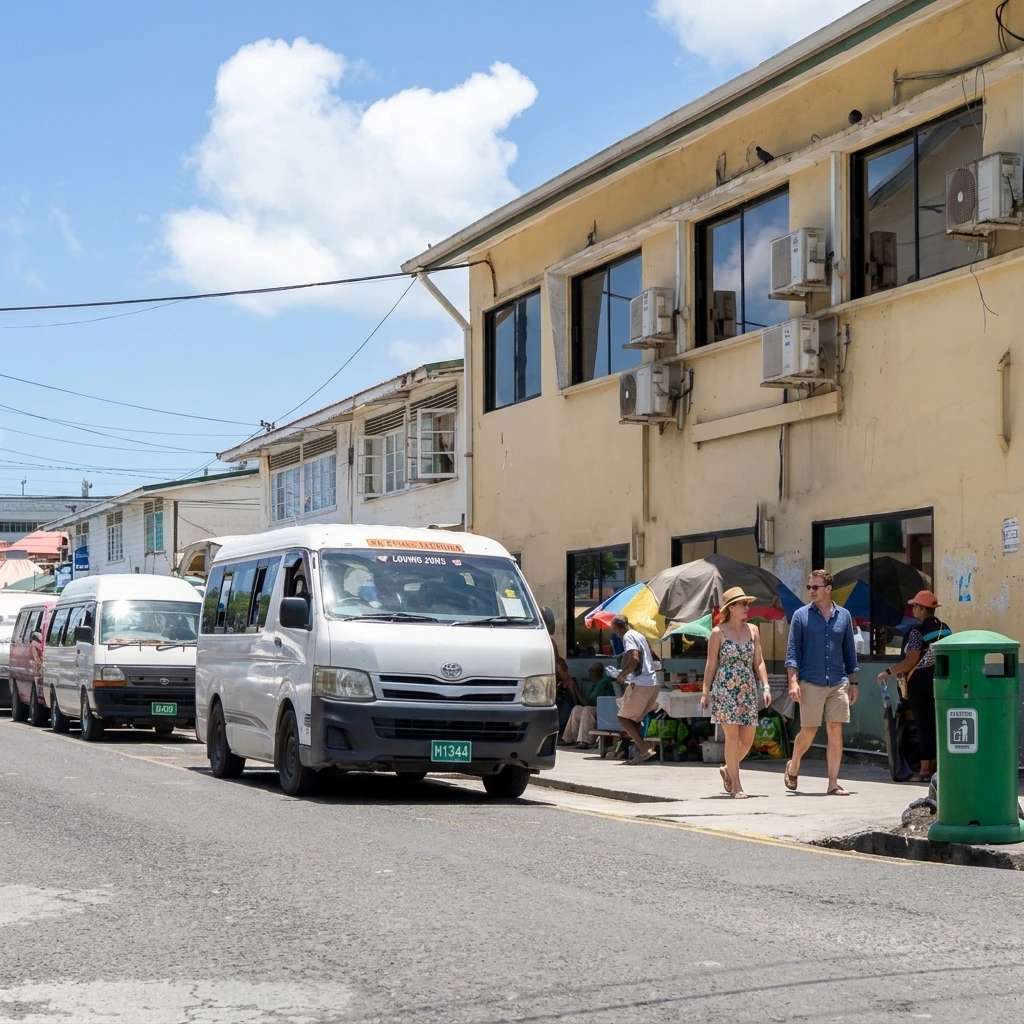
Every island has a transport secret that visitors walk past without noticing. In St Lucia, it is the minibus: the green-plate vans that zip between towns all day, cost less than a bottle of water, and carry most of the island to work, school and market.
Tourists ask us about them constantly, usually in one of two forms. Budget travelers ask "can I really get around for a couple of dollars?" and everyone else asks "are those things safe?" Both deserve honest answers from people who grew up riding them, so here is the complete guide.
Forget city buses with timetables and ticket machines. St Lucia's public transport is a fleet of privately owned minibuses, most seating around 14 passengers, licensed by the government and identified by green number plates starting with the letter M. If the plate is green and starts with M, it is a legal, licensed bus. That plate is your quality check, the same way blue TX plates identify licensed taxis.
Each bus works a set route between towns, shown by a route number in the windscreen. The busiest corridor for visitors is the one between Castries and Gros Islet, which runs right past Rodney Bay. Other routes fan out from Castries to Soufriere, Vieux Fort, Dennery and everywhere between.
Here is the part that surprises visitors: there is no timetable. Buses leave the terminal when they are full, and along the route you simply flag one down from the roadside like a taxi. To get off, you say "bus stop" or press the buzzer, and the driver pulls over at the next safe spot.
This is where budget travelers start smiling. Fares are set by government and paid in cash, in EC dollars, when you get off. As a guide in 2026:
Short hops within a town area cost around EC$2.50 to EC$3, which is about one US dollar. Castries to Rodney Bay or Gros Islet runs a few EC dollars. The long hauls, Castries down to Soufriere or across to Vieux Fort, cost roughly EC$8 to EC$10, still only three or four US dollars for an hour plus of travel.
Compare that with the taxi fares in our route-by-route price list and you can see why the bus is unbeatable on pure price. A journey that costs $80 US by taxi can cost $4 by bus. The catch is everything else, which is where honesty comes in.
Keep small EC notes and coins for fares. Drivers can rarely change large bills, and while some will take US dollars in tourist areas, the rate will not favor you. Our money guide covers where to get EC dollars when it publishes, until then, any ATM dispenses them.
Genuinely fun, most of the time. The music is loud and good, the driving is confident, everyone greets the bus when they board because this is St Lucia and greeting people is the law of the land, and you will see the island the way it actually lives. For the price of a soft drink you get a rolling introduction to St Lucian life that no tour can sell you.
Now the honest limitations, because they are real.
Buses run when full, so quiet times mean waiting. Service thins dramatically in the evening and can be sparse on Sundays and holidays. Buses stick to the main roads, which means they pass resort gates but do not go up the long driveways, and some resorts sit well off the bus routes entirely. There is little room for luggage, so airport arrivals with suitcases are out. And personal space is a concept the minibus has never heard of. None of this is a safety problem, it is a convenience problem.
On safety itself, since visitors ask: riding the licensed green-plate buses is a normal, everyday thing that St Lucian schoolkids, grandmothers and office workers do all day long. Use the same street sense you would anywhere, keep your bag on your lap, and you will be fine.
Use the bus when you are staying near a main road in the north, you are not on a schedule, and the trip is simple: Rodney Bay to Castries market on a morning, Gros Islet for the Friday night street party while the buses are still running, a beach hop along the corridor. It is cheap, it is safe, and it is a genuine slice of island life.
Do not build important plans on it. Airport journeys with luggage, dinner reservations, cruise ship departures, early tours: these need transport that leaves when you need it to. That is what fixed-price private transfers are for, and for a full day of sights, a guided tour beats bus-hopping between attractions that buses do not actually reach, since the waterfalls, Sulphur Springs and viewpoints mostly sit off the bus routes.
The smart traveler's mix, the one we would recommend to a friend on a budget: pre-book the airport legs, use buses for simple daytime hops in the north, and take a proper tour for the Soufriere sights. You get the local experience and the reliability, and the total still comes in far under taxi-everywhere.
How much is the bus in St Lucia? A few EC dollars. Short hops around EC$2.50 to $3, the longest cross-island routes roughly EC$8 to $10, paid in cash when you get off.
How do I know which van is a real bus? Green number plate starting with M, plus a route number in the windscreen. That plate means licensed and insured.
Do the buses run at night? Service fades after the evening rush and is limited on Sundays and holidays. Do not count on a late bus home, that is a taxi moment.
Can I take the bus from UVF airport to my resort? Technically Vieux Fort has bus routes, but with luggage, connections and resort driveways, it is not realistic. See how to get from UVF to your resort for the options that actually work on arrival day.
Is there Uber in St Lucia instead? No, there is no Uber in St Lucia at all. Buses, licensed taxis and pre-booked transfers are the real options.
Do buses go to Soufriere and the Pitons? Buses reach Soufriere town from Castries, but the attractions around it, Sulphur Springs, the waterfalls, the trailheads, sit off the routes. Most visitors do that area as a guided tour day instead.
St Lucia's minibuses are one of the best cheap experiences on the island: a couple of EC dollars, good music, and the real St Lucia rolling past the window. Ride them for the simple daytime hops and enjoy every minute. For the moments that cannot go wrong, airport runs, tours, nights out, put a fixed price and a professional driver on it.
Book your fixed-price transfer for the legs that matter, and spend your bus savings on an extra roti. That is the local way.