
Office Address
Rodney Bay, St. Lucia
Phone Number
+1 7584602257
Email Address
info@tripcarib.com
Rodney Bay, St. Lucia
+1 7584602257
info@tripcarib.com
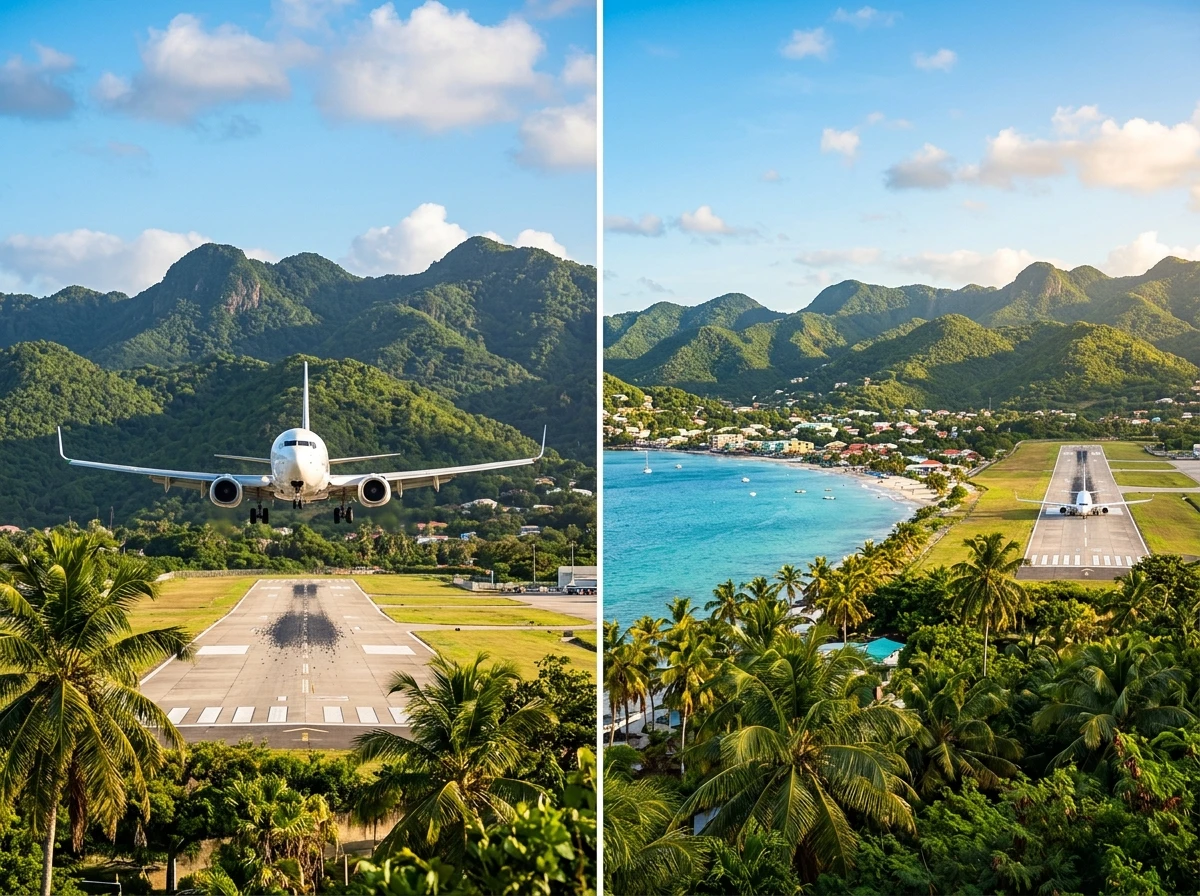
Short answer: check the three-letter code on your ticket. UVF is Hewanorra International, at the southern tip of the island, and it handles almost all flights from the US, UK, Canada and Europe. SLU is George F. L. Charles, a small airport beside Castries in the north, used mainly for regional hops from other Caribbean islands. The difference matters enormously: from UVF, the northern resorts are 75 to 90 minutes away. From SLU, they are 15 to 20. We meet flights at both, so here is everything that changes depending on which one is yours.
Most visitors never think about this until something goes wrong. Someone books a transfer to the wrong airport, or assumes a connection through Barbados lands them in the south when it actually lands them in the north.
It takes thirty seconds to check, and getting it right saves an hour and a half of confusion on arrival day.
Look at the three-letter code on your booking confirmation. UVF means Hewanorra. SLU means George F. L. Charles. That code is on your ticket, your boarding pass and your itinerary email.
If your flight comes direct from a major US, Canadian, UK or European city, it is almost certainly UVF. If you are connecting through Barbados, Antigua, Martinique or another Caribbean island on a small regional aircraft, you may well be landing at SLU.
Worth checking carefully if your booking involves two legs, because the island you connect through does not tell you which St Lucia airport you finish at. Both airports appear as "St Lucia" on some booking sites, which is precisely how people get caught out.
UVF sits in Vieux Fort at the southern tip of the island and handles almost all international traffic. It has the long runway wide-body jets need, which is why the big carriers use it.
What that means for you practically: it is the airport most visitors land at, and it is a long way from most resorts. Rodney Bay, Gros Islet and Cap Estate are 75 to 90 minutes north. Soufriere and the Piton resorts are closer at 45 to 60 minutes. Castries and Marigot Bay sit in between.
The airport itself is small, friendly and straightforward, and our step-by-step guide to landing at Hewanorra walks through immigration, customs, cash and finding your driver in the arrivals hall.
SLU sits right beside Castries in the north, handling regional flights from neighbouring islands. Its short runway cannot take large jets, which is why it is not the international gateway.
If you land here, you are already close to most of the island's hotels. Rodney Bay is 15 to 20 minutes away, Cap Estate 20 to 25, Castries itself under ten. The exception flips the other way: Soufriere is now 75 to 90 minutes from you rather than 45 to 60.
This is the airport served by inter-island carriers, and it is also where the helicopter shuttle from UVF lands if you take that option.
Because the two airports sit at opposite ends of a mountainous island, and the drive between them is over an hour. Booking a transfer to the wrong one is an expensive mistake.
Here is the practical difference laid out:
| Staying at | From UVF | From SLU |
|---|---|---|
| Rodney Bay / Gros Islet | 75 to 90 min | 15 to 20 min |
| Cap Estate | about 90 min | 20 to 25 min |
| Castries | 60 to 75 min | 5 to 10 min |
| Marigot Bay | 60 to 75 min | 25 to 30 min |
| Soufriere / Pitons | 45 to 60 min | 75 to 90 min |
| Vieux Fort | 10 to 15 min | about 90 min |
Notice the reversal at the bottom. Soufriere guests are lucky to land at UVF. Rodney Bay guests are lucky to land at SLU. Full route-by-route detail is in our guide to how long the drive really takes.
Most visitors have no choice, since international flights only serve UVF. If you do have a routing option, pick based on where you are staying.
Staying in the north and offered a connection into SLU? That can be worth taking, since it turns a 90 minute drive into a 20 minute one. Weigh it against the extra connection, the risk of delays and the luggage transfer, because a smooth direct flight into UVF often beats a tight connection that saves an hour on the ground.
Staying in Soufriere or the south? UVF is straightforwardly better, and it is the shortest transfer to the Piton resorts anyway, as our UVF to Soufriere guide explains.
Book it in advance against the correct airport code, and give your flight number so the driver can track it. With no Uber in St Lucia, arrival transport is something to arrange rather than improvise.
Our guide to transfer options and prices for every resort area covers what each route costs from both airports, and what to confirm before booking any transfer lists the nine things worth checking so nothing surprises you at arrivals.
If you are heading to a Sandals property, all three are in the north, so the airport question matters particularly, and we compared them in the Sandals transfer guide.
Tell your transfer company as soon as you know. A good operator will simply reassign a driver to the right airport.
This happens more often than you would think, and it is fixable if you flag it early. What is not ideal is discovering it after landing, when you are standing in the wrong arrivals hall an hour and a half from your booking.
Having a WhatsApp contact for your driver solves this, which is one of the reasons our guide to finding a driver you can rely on stresses getting a direct number before you fly.
Yes, and the drive back is the same distance. Departure day from Rodney Bay to UVF means leaving around five hours before your flight once you add check-in time.
Our departure day timing guide gives the pickup time for every resort area against your flight time, which is the question we get by WhatsApp more than any other.
What is the main airport in St Lucia? Hewanorra International (UVF) in Vieux Fort, at the southern tip. It handles almost all international flights.
What is the difference between UVF and SLU? UVF is the large international airport in the south. SLU is a small regional airport beside Castries in the north. They are at opposite ends of the island.
Which airport is closer to Rodney Bay? SLU, at 15 to 20 minutes. UVF is 75 to 90 minutes away.
Which airport is closer to the Pitons? UVF, at 45 to 60 minutes. From SLU it is 75 to 90 minutes.
Can I fly between the two airports? There is a helicopter shuttle covering UVF to SLU in about 12 minutes, though it costs several times a road transfer and has daylight and luggage restrictions.
How do I check which airport my flight uses? The three-letter code on your ticket. UVF or SLU. Check it before booking any transfer.
Is there a ferry option instead? For inter-island travel, yes. The ferry to Martinique leaves from Castries, not from either airport.
Two airports, opposite ends of the island, and more than an hour between them. Check the three-letter code on your ticket, match your transfer booking to it, and the rest of arrival day takes care of itself.
UVF for almost everyone flying internationally. SLU if you are hopping in from a neighbouring island. Either way, book the ride before you fly.
Get a fixed-price transfer from either airport, with flight tracking and a driver waiting with your name.